






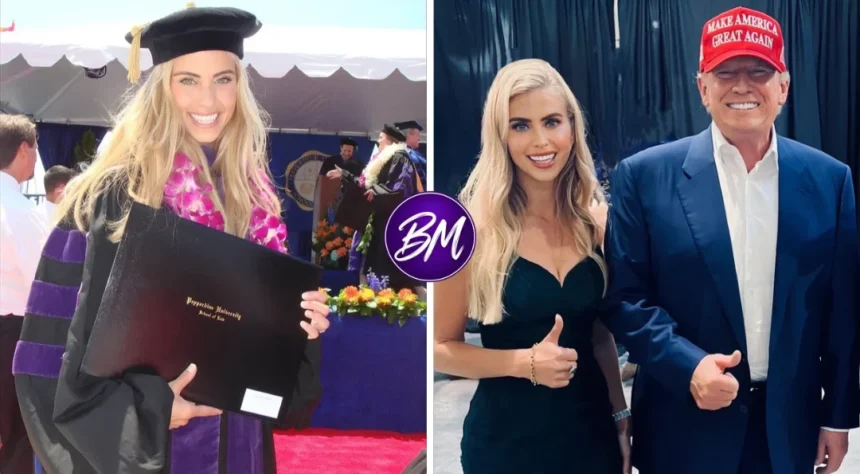
Pepperdine University identifies Katie Zacharia as a 2007 undergraduate alumna and a 2011 law graduate. Its public account also confirms that she later worked for the university and joined the Dean’s Council at its Caruso School of Law. Those details provide a clearer account of her education than biographies that infer qualifications from her television or political work.
The distinction has become more relevant since Pepperdine announced on October 9, 2026, that Zacharia had been named the next White House press secretary. The university’s announcement identifies her as Katie Zacharia and gives the alumni notation “’07, JD ’11.” It describes both her education and several later connections to Pepperdine.
What did Katie Zacharia study?
According to Pepperdine, Zacharia graduated from its Seaver College with a degree in political science and government. The university identifies 2007 as her undergraduate alumni year.
She then earned a Juris Doctor in 2011 from Pepperdine’s Caruso School of Law. A Juris Doctor, usually abbreviated JD, is a law degree. The two dates therefore refer to separate stages of her education: undergraduate study in 2007 and completion of law school in 2011.
That distinction is easy to lose when a short biography says only that she “attended Pepperdine.” The university’s account is more precise. It identifies the subject she studied as an undergraduate and separately confirms her law degree. It does not require readers to guess whether she earned one degree or two.
The university uses her full name, Katie S. Zacharia, in its law school records. That fuller identification helps connect the law graduate and council member to the Katie Zacharia discussed in its October 2026 announcement.

What does Pepperdine say about her experience as a student?
Pepperdine reports that Zacharia interned at the White House during George W. Bush’s administration while she was a law student. It also says she worked as a research assistant to Jim Gash when he was a professor of law. Gash later became Pepperdine’s president and chief executive officer.
These are useful details, but they should be read at the level the university provides them. Its announcement does not give the exact dates of the internship, describe her day to day duties or identify a particular research project. It confirms the experiences without supplying a complete account of either position.
Her student experience also should not be confused with her later jobs. An internship during law school, a research assistant role and a university staff position are different kinds of work at different points in a career.
Did Katie Zacharia work at Pepperdine after graduating?
Yes. Pepperdine says Zacharia served as its director of development for special projects from 2023 to 2025. This was a later professional role at the university, not another academic degree.



The university also identifies her as a member of the Dean’s Council at Caruso School of Law. Council membership shows an ongoing connection to the law school after graduation. It does not mean that she is currently a student or that she holds a teaching position. Those descriptions would need separate evidence.
Taken together, the public university information shows more than a pair of graduation years. Zacharia studied at Pepperdine, returned for a staff role and remained involved with its law school. Each connection is distinct, and describing it accurately is more useful than treating every university affiliation as an academic credential.
What do the university records not establish?
Pepperdine’s public announcement is an account of an alumna’s background. It is not a transcript or a complete employment history. It does not disclose Zacharia’s grades, class rank, individual courses or the full responsibilities of every role she held. Readers should not add honors or achievements that the university does not identify.
A JD also should not be used by itself to make claims about a person’s current license to practice law. A degree confirms legal education. Licensing status is a separate question that requires the relevant professional record.
The same care applies to claims about how Zacharia’s studies affected her later opinions or decisions. Her degrees and university roles are documented. A claim that a particular course, professor or internship caused a later political position would need evidence from Zacharia or another source with direct knowledge.
The difference becomes clear in our Lupe Gidley profile. A theater degree is repeated in online biographies about Gidley, but no official school record was found to confirm it. Pepperdine, by contrast, identifies Zacharia’s degrees directly.
Why are people looking at her education now?
Pepperdine published its detailed alumni announcement after Zacharia was named the next White House press secretary on October 9, 2026. The word “next” matters: the announcement reports an appointment, and should not be rewritten to suggest she had already held the position for an extended period.
The university also summarized her work in communications, government and media. Those roles explain the current interest in her background, while its records answer the narrower education question. They establish where she studied, what degree subject Pepperdine identifies and when she completed law school.
Did Katie Zacharia graduate from Pepperdine University?
Yes. Pepperdine identifies her as a 2007 undergraduate alumna of Seaver College and a 2011 JD graduate of its Caruso School of Law.
Was Katie Zacharia a Pepperdine professor?
Pepperdine’s announcement identifies her as a former director of development for special projects and a Dean’s Council member. It does not identify her as a professor.
Does Pepperdine publish her full academic record?
No. Its public account confirms her degrees and selected roles, but it is not a transcript and does not provide grades or class rank.
Pepperdine’s public information gives a firm answer to the main question: Katie Zacharia studied political science and government as an undergraduate, earned a JD in 2011, and later maintained professional and council ties to the university. Details beyond that record should be attributed to a source that can actually verify them.