







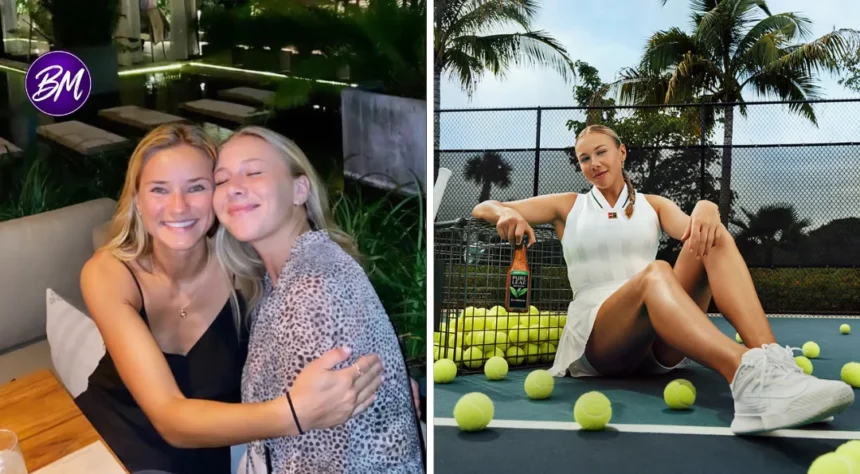
Maria Egee did play competitive tennis. Amanda Anisimova’s older sister represented the University of Pennsylvania under the name Maria Anisimova, earned All-Ivy recognition and reached the NCAA doubles round of 16.
An injury prevented her from competing during the 2009–10 season, her final year on Penn’s roster. However, that record does not establish that injury permanently ended her tennis ambitions. What is clear is that her subsequent professional career developed in finance rather than on the international tennis tour.
Her story therefore begins with a correction: Maria was an accomplished college player before she became familiar to audiences following her younger sister.
Maria Egee Played Tennis Before Amanda Became Famous
Maria’s university record shows years of competitive experience. She joined Penn’s women’s team as a freshman for the 2006–07 season and remained listed through her senior year in 2009–10.
Before college, her achievements included winning the girls’ 18-and-under Copper Bowl in 2005. Penn also recorded a top-30 national ranking in that junior age group.
These results show that tennis was a serious pursuit. Describing Maria only as a spectator in Amanda’s player box leaves out the competitive background that connects her to the sport.


Her university records use Maria Anisimova, while the WTA identifies Amanda’s sister as Maria Anisimova-Egee. Readers may therefore encounter different versions of her name when looking through older results.
Her College Results Included a Penn First
One of Maria’s strongest achievements came during her freshman season.
In May 2007, she and Ekaterina Kosminskaya became the first women’s doubles team in Penn history to compete at the NCAA Championships. They then won their opening match against LSU’s Megan Falcon and Hannah Robinson, advancing to the round of 16.
Their tournament ended with a defeat against Vanderbilt’s Amanda Fish and Amanda Taylor. Nevertheless, qualifying and winning a match established a milestone for Penn’s program.



Maria also earned recognition in singles. Following the 2008–09 season, the Ivy League named her to its second team. Penn’s contemporary report recorded a winning 4–3 conference singles record, with Maria usually playing at No. 2.
Her documented tennis progression includes:
| Period | Achievement or development |
|---|---|
| 2005 | Won the girls’ 18-and-under Copper Bowl |
| 2006 | Won the college invitational’s singles C bracket |
| 2007 | Reached the NCAA doubles round of 16 |
| 2009 | Earned second-team All-Ivy singles recognition |
| 2009–10 | Did not compete because of injury |
These are college and junior achievements. They should not be confused with professional WTA rankings or Grand Slam results.
What the Injury Record Actually Explains
Penn’s senior-season biography gives a brief explanation for Maria’s absence: she did not compete because of injury.
That answers why she missed the 2009–10 college season. However, the university page does not identify the injury, describe its long-term effects or announce a permanent retirement.
It would therefore go too far to say that a specific medical problem forced her to abandon a professional career. No direct statement located for this article establishes that conclusion.
The distinction matters because missing a season and deciding against a touring career are separate questions. Maria’s injury is documented; her complete reasoning about life after college is not.
Wharton Led to a Different Professional Career
Alongside tennis, Maria studied at Penn’s Wharton School. Her official employer biography identifies a finance qualification from Wharton and a subsequent career in financial markets.
According to Loop Capital Asset Management, Maria began at Goldman Sachs, where she spent seven years trading securities and credit derivatives. She later worked as a senior credit trader at Bank of America.
Loop Capital currently lists her as a senior vice president and portfolio manager. Its biography describes responsibilities involving investment policy, strategy and portfolio management.
This provides a concrete answer to what followed her competitive college years. She built a professional career outside sport.
However, the record does not establish that she selected finance because of the injury, rejected tennis for financial reasons or had always intended to follow this route. Those explanations would require her own account.
Maria Helped Amanda Discover Tennis
Maria’s career took a different direction, but her influence on Amanda’s introduction to tennis is documented.
The WTA’s official biography explains that Amanda regularly attended her older sister’s practices. Watching Maria helped her develop an interest in playing.
That family connection is also described in Amanda Anisimova’s background. Before Amanda’s professional results attracted international attention, Maria provided an example of someone already training and competing.
The sisters ultimately developed different careers. Amanda pursued professional tennis, while Maria combined college competition with business studies and later entered finance.
There is no need to treat those outcomes as a competition between them. Maria’s college achievements stand independently, and her influence belongs in the story of how Amanda first encountered the sport.
Does Maria Egee Still Play Tennis?
The sources reviewed do not establish how often Maria currently plays recreationally. Working in finance does not prove that she never picks up a racket, just as attending Amanda’s matches does not establish an active competitive schedule.
The clearest answer is that Maria played serious junior and college tennis, missed her final college season through injury and subsequently built a finance career. The broader question of why she did not pursue a sustained professional tennis career remains only partly answered by the public record.
For more business coverage, explore our article on Ramon Laguarta and Marillyn Hewson’s leadership timelines.