






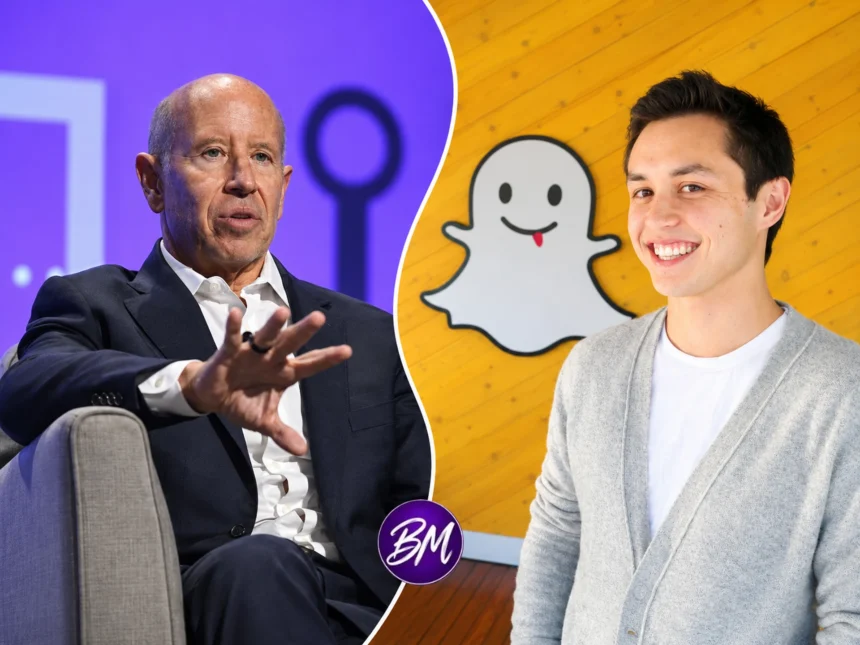
Barry Sternlicht founded Starwood Capital Group in 1991, during the savings and loan crisis. Bobby Murphy co-founded the business behind Snapchat, which launched its first photo-messaging app in 2011. By September 2026, Starwood reported more than $130 billion in assets under management, while Snapchat averaged 977 million monthly active users in the third quarter. Sternlicht still leads Starwood Capital as chairman and CEO. Murphy has served as Snap’s chief technology officer and a board member since May 2012.
| Barry Sternlicht | Bobby Murphy | |
|---|---|---|
| Company | Starwood Capital Group | Snap Inc. |
| When he started | Founded Starwood Capital in 1991 | Co-founded the business behind Snapchat, whose app debuted in 2011 |
| Current role | Chairman and CEO | Chief technology officer and board member |
| Reported reach in 2026 | More than $130 billion in assets under management as of September | 977 million monthly and 495 million daily active users in the third quarter |
How Barry Sternlicht built Starwood Capital Group
Sternlicht started Starwood when the savings and loan crisis had put pressure on commercial real estate. The firm’s first two opportunity funds closed in 1992 at a combined $52 million. In 1993, those funds contributed most of their apartment portfolio to Equity Residential, and Sternlicht served on its board. Within two years of launching the firm, he had already used a privately raised fund to assemble a portfolio that became part of a publicly traded apartment business.
Hotels gave Sternlicht another way to expand. In 1994, a Starwood affiliate bought a majority of the distressed senior debt of Hotel Investors Trust. The following year, Starwood Capital bought Westin and created Starwood Hotels & Resorts Worldwide, with Sternlicht as chairman and CEO. The hotel company completed its acquisition of ITT Sheraton in 1998, the same year the first W Hotel opened in New York. Those moves gave the hotel business both an established network of properties and a new brand of its own.
Marriott acquired Starwood Hotels & Resorts Worldwide in September 2016. Starwood Capital Group continued operating as a private investment firm. In 2025, its hospitality affiliate SH Hotels & Resorts revived the Starwood Hotels name for the business behind 1 Hotels, Baccarat Hotels and Treehouse Hotels. The shared name spans three different businesses and two eras of Sternlicht’s hotel career.
Sternlicht’s early deals came during a period when other property investors were also taking on distressed assets. In New York, Jerry Speyer’s work at Rockefeller Center shows how a developer approached a major property emerging from bankruptcy.
How far does Starwood Capital reach today?
Starwood Capital says it has invested in more than 35 countries since its founding. Its broader organization, including affiliates and externally managed public companies, has about 7,000 employees across 20 offices in nine countries. The country count describes where the firm has invested over time, while the office count shows where its teams are based.

A July 2026 fundraising announcement shows how much the business has changed since its first fund closings. Starwood announced more than $10.2 billion in commitments for its thirteenth distressed opportunity fund, backed by more than 300 investors from about 20 countries. The fund targets housing, industrial properties, data centers and hotels, primarily in the United States and Europe, with selected investments in Asia-Pacific. By the time it announced the final close, Starwood said the fund had already closed or committed to 20 transactions.
How Bobby Murphy helped build Snapchat
Murphy and Evan Spiegel co-founded the business behind an iPhone app first known as Picaboo. It launched in 2011 and became Snapchat later that year. The app opened to the camera and made sending a temporary photo to a friend quick. In a 2013 Associated Press interview, Spiegel recalled that Murphy had a job that helped cover the early server bills. As usage grew, those bills became difficult to fund, and the company turned to outside investment.
Snapchat expanded to Android in 2012 and introduced Stories in October 2013. Stories let people share a sequence of photos and videos that friends could watch over the next 24 hours. Later, Lenses made the camera interactive by adding effects that moved with a person’s face or changed the scene on screen. The app had grown to 158 million average daily active users by the fourth quarter of 2016. The company took the name Snap Inc. that year and went public in March 2017 under the ticker SNAP.
How far does Snap Inc. reach today?
In the third quarter of 2026, Snapchat averaged 495 million daily active users, a little over three times the figure Snap reported at the end of 2016. It also averaged 977 million monthly active users. Snap’s regional figures show how much of that reach extends beyond its original U.S. market. About 305 million of its daily users were in the company’s “Rest of World” reporting region, which excludes North America and Europe.



Snap posted $1.72 billion in quarterly revenue, up 14% year over year. Advertising still accounted for most of its revenue. The company also reported more than 30 million paid subscribers across offerings that include Snapchat+, Memories Storage and Lens+. That gives Snap another way to earn revenue from the audience it built around the camera. The figures appear in Snap’s third-quarter 2026 SEC filing and its accompanying investor remarks.
What do Sternlicht and Murphy have in common?
Both stayed in leadership as their companies expanded, and each took an early idea into new markets. Sternlicht built from apartment investments into hotels, real estate lending and data centers. Murphy helped take a disappearing-photo app from the iPhone to Android and into a platform that could support advertising and paid subscriptions. Starwood’s growth depended on raising capital and finding properties where it could put that money to work. Snap’s depended on giving people enough reasons to open the camera and come back the following day.