





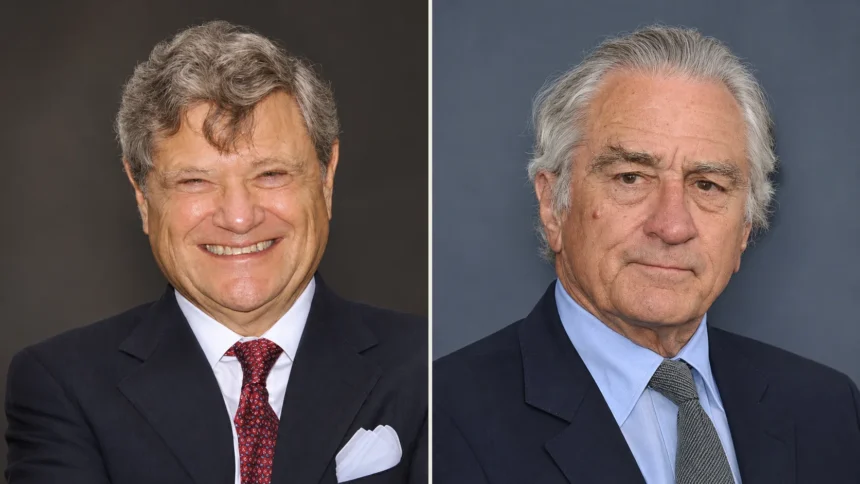
Jerry Speyer built his career in Manhattan real estate. Robert De Niro took acting classes in New York and turned the neighborhoods he knew into material for his films. Their careers eventually crossed in two documented ways. Both became founding trustees of the 9/11 Memorial & Museum, and in 2007, Speyer’s firm hosted an outdoor film series programmed by the company De Niro helped found.
Jerry Speyer’s Rise in New York Real Estate
Speyer earned his undergraduate degree from Columbia College in 1962 and his MBA from Columbia Business School in 1964. He went into business with Robert Tishman, his father-in-law and an executive in an established New York real estate family. The older family company went private and sold properties in the 1970s. In 1978, Speyer and Tishman formed their own firm, Tishman Speyer. By 1995, its Manhattan portfolio included 520 Madison Avenue.
Rockefeller Center became one of the firm’s defining New York projects. The complex went through bankruptcy in the mid-1990s. Tishman Speyer joined the investment group that acquired it in 1996 and managed the property through a period of restoration. In December 2000, the firm and Chicago’s Crown family agreed to buy out their partners at a property valuation of $1.85 billion. One visible result of the restoration came in 2005, when the Top of the Rock observation deck reopened after nearly two decades.
Barry Sternlicht also saw opportunity in distressed real estate in the 1990s, building Starwood Capital through early apartment investments before expanding into hotels.
On the West Coast, Richard Peery built a different kind of commercial property business through Silicon Valley office parks. Our article on Richard Peery and John Paulson looks at what public records show about a possible investment.
The $5.4 Billion Deal That Went Wrong
Speyer’s firm faced a different outcome at Stuyvesant Town and Peter Cooper Village. In 2006, an investment group led by Tishman Speyer and BlackRock Realty bought the two Manhattan apartment complexes for about $5.4 billion. The investment depended in part on generating more rental income by moving rent-regulated apartments to market rates. Tenants challenged the practice. In 2009, New York’s highest court held that the owners could not use those deregulation provisions while receiving benefits under the city’s J-51 tax program.

The real estate downturn also put pressure on the heavily financed purchase. After missing a loan payment, the ownership group announced in January 2010 that it would turn control over to creditors. The episode illustrates the difference between Speyer’s two best-known Manhattan deals. At Rockefeller Center, restoring a landmark opened up ways to attract visitors and businesses. At Stuyvesant Town, projected income depended on changes to rents that tenants successfully challenged.
Robert De Niro’s Years Before His Breakthrough
De Niro grew up in Greenwich Village, the son of two painters, and spent time in nearby Little Italy. He recalled that his mother did typing and proofreading for Maria Ley-Piscator and that, as part of her compensation, he got to take Saturday acting classes when he was about ten. He later studied with Stella Adler and went to the Actors Studio at 18. His mother’s arrangement gave him an early opening. It took years of training and work before audiences knew his name.
Two 1973 films showed how much range he had. In Bang the Drum Slowly, he played a baseball catcher facing a terminal illness. In Mean Streets, his first film with Martin Scorsese, he played the volatile Johnny Boy. His performance as young Vito Corleone in The Godfather Part II brought him his first Oscar in 1975. He won his second in 1981 for playing boxer Jake LaMotta in Raging Bull, another collaboration with Scorsese.
New York also gave De Niro material when he moved into directing. For A Bronx Tale, his 1993 directorial debut, he drew on memories of hanging around Little Italy as a boy. He remembered how younger kids watched older men at a neighborhood social club and wanted to act grown up themselves. Those observations helped him shape the neighborhood he was putting on screen.



How Their Paths Crossed After 9/11
After September 11, De Niro, producer Jane Rosenthal, and Craig Hatkoff looked for ways to bring people back to Lower Manhattan. De Niro recalled organizing dinners that brought visitors to local restaurants. The three had discussed a film festival before the attacks, and the recovery effort gave the idea urgency. The first Tribeca Film Festival took place in May 2002, with screenings, panel discussions, and a family program. Tribeca continues to premiere documentaries, including The DOC, which featured Puma Badu and debuted at the festival in 2022.
A New York City record dated December 1, 2004 lists both De Niro and Speyer on the World Trade Center Memorial Foundation board. The city identified De Niro with the Tribeca Film Institute and Speyer with Tishman Speyer Properties. The 9/11 Memorial & Museum still lists both as founding trustees. Their shared board service was separate from De Niro’s work launching the festival.
Their organizations also worked together in Midtown. At the 2007 Tribeca Drive-In at Rockefeller Center, Tishman Speyer hosted free outdoor screenings and Tribeca Enterprises selected the films. The program brought independent features to a large screen outside 30 Rockefeller Plaza and included a short-film showcase at Top of the Rock. The event records establish what each organization contributed.
Public filings trace a different kind of business connection between Joel Greenblatt and Jim Farley through Gotham’s investment in Ford.
Another link between business and film came through screenwriter Charles Randolph, whose work on Bombshell and a proposed WeWork feature explains the indirect connection between Masayoshi Son and Margot Robbie.
What Did Jerry Speyer and Robert De Niro Have in Common?
Both men used relationships they had built in New York to take on work beyond their original professions. Speyer’s real estate career extended into cultural leadership, including chairing the Museum of Modern Art’s board. De Niro went from acting and directing to helping build a festival where independent filmmakers could reach audiences. Their setbacks were different, too. De Niro spent years finding his footing as an actor. Speyer’s most visible setback came after he was already established, when a major property investment failed.
The Rockefeller Center screenings show what their careers could bring to the same project. A property owner could make a Midtown plaza available to the public, while a film organization could give people a reason to spend an evening there. That collaboration put independent films in front of an audience in one of the city’s busiest public spaces.